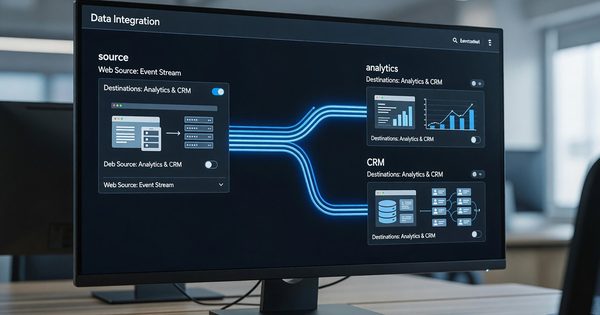
The reverse-ETL category stopped being a category. Fivetran acquired Census in October 2025, Hightouch is the reference implementation everyone benchmarks against, and both major CDPs now ship warehouse activation as a feature rather than a partnership. What used to be a three-tool decision — event pipeline, warehouse, activation layer — is mostly a two-tool decision now, and the tool you pick for the first slot determines how much of the third you still have to buy.
If you are choosing between Segment and RudderStack in 2026, three differences do the actual work. The rest is comparison-page noise.
The billing unit determines your cost curve, not the list price
Segment bills on monthly tracked users. RudderStack bills on event volume. Entry pricing looks close enough to be misleading — roughly $120/month for Segment’s Team tier against $220/month for RudderStack’s Starter — but the curves diverge hard as you scale, and they diverge in opposite directions depending on your product shape.
A B2B SaaS product with 200,000 monthly visitors and 50,000 identified users lands somewhere around $3,000–$5,000 per month on Segment. The same traffic on an event-volume model depends entirely on how chatty your instrumentation is: a handful of lifecycle events per user is cheap, a full clickstream is not.
The shape that punishes MTU pricing hardest is high-user, low-conversion — media, consumer apps, anything with a large anonymous or free tier. Every user is priced whether or not they ever generate revenue. The shape that punishes event pricing hardest is the opposite: a small user base with heavy in-product telemetry, where you are effectively paying CDP rates to move product analytics data.
Before you model anything, count the two numbers for your own traffic: distinct identified users per month, and events per user per month. One of those numbers is going to be embarrassing, and it tells you which vendor’s meter runs against you.
Storage is the architectural difference
RudderStack’s warehouse-first design treats your Snowflake, BigQuery or Redshift instance as the source of truth rather than a destination, and it does not store your data. Segment stores customer data in its own infrastructure and exposes it through Profiles.
This is not a philosophical distinction, it has three concrete consequences:
Replay. With a warehouse-first pipeline, re-sending history to a new destination means re-running a query. With a vendor-stored model, replay is a vendor feature with vendor limits.
Data residency and deletion. If your compliance posture requires that customer records live in infrastructure you control, a CDP that stores profiles is an additional processor to document, assess and include in deletion workflows. If it does not store them, it is a transit layer. That difference shows up in vendor reviews and in every deletion-request runbook you write.
Modelling. Identity resolution and trait computation in the warehouse is dbt you already know how to test. Identity resolution inside a CDP is configuration with less observability. Teams with a mature warehouse practice tend to want the logic where their tests are.
Reverse ETL is included in RudderStack’s free tier with ten connections, which is enough to activate warehouse data into a CRM and a marketing tool without a separate purchase. Segment’s reverse-ETL capability arrives through Profiles, where pricing is opaque and typically enterprise-contracted. If the plan was “buy a CDP and a reverse-ETL tool,” check whether the second purchase is still necessary before you budget for it.
Ownership and lock-in, stated plainly
Segment has been part of Twilio since the 2020 acquisition and operates as Twilio Segment. RudderStack remains independent and positions itself as the warehouse-first alternative. RudderStack’s free tier runs to 25 million events per month with unlimited sources and destinations, which is generous enough to run a real evaluation rather than a toy one.
For an engineering team the lock-in question is narrower than the corporate one: how much of your instrumentation is portable? Both use an analytics.js-compatible client API, and both speak the same track/identify/group vocabulary. That means the collection layer moves with modest effort. What does not move cheaply is destination-specific transformation logic, identity-resolution configuration, and anything downstream that consumed vendor-specific schema. Keep transformations in version control and out of the vendor UI, and a future migration becomes a re-point rather than a rewrite.
How to run the evaluation in a week
Instrument one real surface — not a demo page — with both SDKs side by side, sending to a test warehouse schema each. Then measure four things:
- Delivery completeness. Count events at the source and in the warehouse. Small, consistent gaps are usually ad-blocker or consent behaviour; large or inconsistent gaps are worth understanding before you commit.
- Latency to warehouse. Note the actual p95, not the marketing number, because it sets what “near real time” means for your activation use cases.
- Cost against your real traffic. Take one full week of production volume and run both meters over it.
- Failure behaviour. Send malformed events deliberately. Find out whether they are rejected, silently dropped, or delivered with nulls into your warehouse, because you will be debugging exactly this at some point.
The answer for most teams with an existing warehouse and a dbt practice is the warehouse-first pipeline, for the straightforward reason that it puts the modelling where the tests already are. The answer for teams without a warehouse practice is often the opposite: a stored-profile CDP is doing real work you would otherwise have to build. Pick against the infrastructure you actually have, not the one on next year’s roadmap.