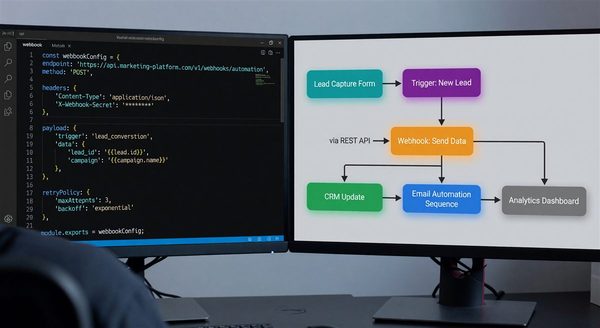
Marketing automation systems are among the hardest to test thoroughly. The happy path is easy to verify: trigger an event, confirm the email was sent, check the CRM update. The failure modes are where things get interesting — webhook delivery during downtime, duplicate event processing, consent state inconsistencies, and timezone-related scheduling bugs that only surface on specific days of the month.
Testing automation pipelines requires a different approach than testing standard application code. The external dependencies (SendGrid, HubSpot, Salesforce), the time-based triggers, and the event-driven architecture all require specific testing strategies that are not covered in standard unit testing guides.
Why Marketing Automation Is Hard to Test
The specific challenges:
External service dependencies. Most automation actions involve third-party APIs (CRM updates, email sends, ad audience syncs). Real API calls in tests are slow, expensive, and non-deterministic. Mocking them correctly requires understanding the exact response format and failure modes of each service.
Time-dependent behavior. Drip email sequences, scheduled campaigns, and time-decay logic depend on timestamps. Tests that rely on datetime.now() produce different behavior depending on when they run. Testing a “send after 3 days” automation requires controlling time.
Event ordering. Automation pipelines often have order-dependent logic: “if the user opens the first email, send this; if they don’t open it, send that.” Testing these branches requires reliable event sequencing.
State accumulation. Automation sequences build state over time — contact properties in the CRM, suppression list status, engagement counters. Tests that share state across runs produce intermittent failures.
The idempotency requirement. Webhook handlers must be idempotent (processing the same event twice must be safe). Testing idempotency requires deliberately sending duplicate events and verifying the handler behaves correctly.
Testing Layer by Layer
Layer 1: Unit Tests for Handler Logic
Unit tests for webhook handlers and event processors should be fast, isolated, and comprehensive of branch logic. The key is dependency injection — pass in mocked services rather than using real ones:
import pytest
from unittest.mock import Mock, patch, call
from datetime import datetime, timezone
from freezegun import freeze_time

from your_app.handlers import SubscriptionEventHandler

class TestSubscriptionHandler:

    def setup_method(self):
        """Create fresh mocks for each test."""
        self.mock_crm = Mock()
        self.mock_email_service = Mock()
        self.mock_warehouse = Mock()
        self.mock_idempotency_store = Mock()

        self.handler = SubscriptionEventHandler(
            crm=self.mock_crm,
            email_service=self.mock_email_service,
            warehouse=self.mock_warehouse,
            idempotency_store=self.mock_idempotency_store
        )

    def test_subscription_created_triggers_welcome_email(self):
        """Subscription created event should trigger welcome email."""
        event = {
            'id': 'evt_001',
            'type': 'customer.subscription.created',
            'data': {
                'object': {
                    'id': 'sub_123',
                    'customer': 'cus_456',
                    'status': 'active',
                    'items': {
                        'data': [{
                            'price': {
                                'nickname': 'Pro Monthly',
                                'unit_amount': 4900,
                                'recurring': {'interval': 'month'}
                            },
                            'quantity': 1
                        }]
                    },
                    'start_date': 1700000000,
                    'current_period_end': 1702592000
                }
            }
        }

        self.mock_crm.upsert_contact.return_value = {'id': 'hs_contact_789'}
        self.mock_idempotency_store.set_if_not_exists.return_value = True  # Not duplicate

        self.handler.handle(event)

        # Assert CRM was updated correctly
        self.mock_crm.upsert_contact.assert_called_once()
        crm_call_args = self.mock_crm.upsert_contact.call_args[0][0]
        assert crm_call_args['properties']['subscription_status'] == 'active'
        assert crm_call_args['properties']['subscription_plan'] == 'Pro Monthly'

        # Assert welcome email was sent
        self.mock_email_service.send_welcome_email.assert_called_once()
        email_args = self.mock_email_service.send_welcome_email.call_args
        assert 'customer_id' in str(email_args)

    def test_duplicate_event_is_skipped(self):
        """Duplicate events (same event_id) should not be processed again."""
        event = {'id': 'evt_duplicate', 'type': 'customer.subscription.created', 'data': {...}}

        # Simulate already processed
        self.mock_idempotency_store.set_if_not_exists.return_value = False

        self.handler.handle(event)

        # Nothing should have been called
        self.mock_crm.upsert_contact.assert_not_called()
        self.mock_email_service.send_welcome_email.assert_not_called()

    @freeze_time("2026-03-15 14:30:00")
    def test_drip_email_scheduled_for_correct_time(self):
        """Onboarding email should be scheduled 3 days after subscription start."""
        event = self._subscription_created_event(start_timestamp=1741900200)
        self.mock_idempotency_store.set_if_not_exists.return_value = True

        self.handler.handle(event)

        # Verify the email is scheduled for 3 days from now
        self.mock_email_service.schedule_email.assert_called_once()
        scheduled_args = self.mock_email_service.schedule_email.call_args[1]
        expected_send_at = datetime(2026, 3, 18, 14, 30, 0, tzinfo=timezone.utc)
        assert scheduled_args['send_at'] == expected_send_at

    def test_payment_failure_increments_dunning_count(self):
        """Sequential payment failures should use the correct dunning email."""
        for attempt in [1, 2, 3]:
            event = self._payment_failed_event(attempt_count=attempt)
            self.mock_idempotency_store.set_if_not_exists.return_value = True

            self.handler.handle(event)

        # Should have sent 3 different dunning emails
        assert self.mock_email_service.send_dunning_email.call_count == 3
        calls = self.mock_email_service.send_dunning_email.call_args_list
        assert calls[0][1]['attempt'] == 1
        assert calls[1][1]['attempt'] == 2
        assert calls[2][1]['attempt'] == 3
Layer 2: Integration Tests with Real External Services in Sandbox Mode
Unit tests verify logic but not actual service behavior. Integration tests use real API calls to sandbox/test environments to verify end-to-end behavior:
import pytest
import time
import requests

class TestStripeHubSpotIntegration:
    """
    Integration tests using Stripe test mode and HubSpot sandbox.
    These tests are slow (~30-60 seconds each) and should run in CI
    on a separate schedule from unit tests.
    """

    @pytest.fixture(autouse=True)
    def cleanup(self):
        """Clean up test contacts after each test."""
        test_emails = []
        yield test_emails
        for email in test_emails:
            try:
                hubspot.delete_contact_by_email(email)
            except:
                pass

    def test_stripe_subscription_creates_hubspot_contact(self, cleanup):
        """End-to-end: Stripe subscription created → HubSpot contact with correct properties."""
        test_email = f"test+{int(time.time())}@example.com"
        cleanup.append(test_email)

        # Create Stripe customer and subscription in test mode
        customer = stripe.Customer.create(
            email=test_email,
            payment_method='pm_card_visa',  # Stripe test payment method
            invoice_settings={'default_payment_method': 'pm_card_visa'}
        )

        subscription = stripe.Subscription.create(
            customer=customer.id,
            items=[{'price': STRIPE_TEST_PRICE_ID}],
            expand=['latest_invoice.payment_intent']
        )

        assert subscription.status == 'active'

        # Wait for webhook to be processed (Stripe delivers in 1-5 seconds)
        time.sleep(10)

        # Verify HubSpot contact was created/updated
        hs_contact = hubspot.get_contact_by_email(test_email)
        assert hs_contact is not None
        assert hs_contact['properties']['subscription_status'] == 'active'
        assert hs_contact['properties']['stripe_customer_id'] == customer.id
Layer 3: Contract Testing for External APIs
Contract tests verify that your integration code correctly handles the response format that external APIs return. They are faster than integration tests and do not require network access, but more realistic than unit tests that use hand-crafted mock responses.
Tools like Pact enable consumer-driven contract testing. Your code defines the contract (what response it expects), and a separate process verifies that the actual API fulfills that contract.
# Using responses library for HTTP mocking with realistic payloads
import responses

@responses.activate
def test_hubspot_contact_creation_with_realistic_response():
    """Test HubSpot API interaction with a realistic response body."""

    responses.add(
        method=responses.POST,
        url='https://api.hubapi.com/crm/v3/objects/contacts',
        json={
            'id': '12345678',
            'properties': {
                'email': 'user@example.com',
                'firstname': 'Jane',
                'lastname': 'Smith',
                'createdate': '2026-03-15T14:30:00.000Z',
                'lastmodifieddate': '2026-03-15T14:30:00.000Z',
                'hs_object_id': '12345678'
            },
            'createdAt': '2026-03-15T14:30:00.000Z',
            'updatedAt': '2026-03-15T14:30:00.000Z',
            'archived': False
        },
        status=201,
        headers={'Content-Type': 'application/json'}
    )

    result = crm_service.create_contact('user@example.com', 'Jane', 'Smith')

    assert result['id'] == '12345678'
    assert len(responses.calls) == 1

    # Verify the request body was correct
    request_body = responses.calls[0].request.body
    parsed = json.loads(request_body)
    assert parsed['properties']['email'] == 'user@example.com'
Testing Time-Based Automation
Time-dependent tests are the most common source of flaky automation tests. Use the freezegun library to control time:
from freezegun import freeze_time

class TestDripEmailSequence:

    @freeze_time("2026-03-15 10:00:00")
    def test_day_1_email_sent_immediately(self):
        user = create_test_user(signup_at="2026-03-15 10:00:00")

        drip_engine.process_pending_sends()

        assert email_service.sent_to(user.email, template='day_1_welcome')

    @freeze_time("2026-03-18 10:00:00")  # 3 days later
    def test_day_3_email_sent_three_days_after_signup(self):
        user = create_test_user(signup_at="2026-03-15 10:00:00")

        drip_engine.process_pending_sends()

        assert email_service.sent_to(user.email, template='day_3_value_prompt')

    @freeze_time("2026-03-22 10:00:00")  # 7 days later
    def test_day_7_email_triggered_only_if_not_converted(self):
        converted_user = create_test_user(signup_at="2026-03-15", plan='paid')
        unconverted_user = create_test_user(signup_at="2026-03-15", plan='trial')

        drip_engine.process_pending_sends()

        assert not email_service.sent_to(converted_user.email, template='day_7_conversion_push')
        assert email_service.sent_to(unconverted_user.email, template='day_7_conversion_push')
Testing Webhook Security
Webhook signature verification is security-critical. Test it explicitly:
def test_webhook_rejects_unsigned_request():
    response = test_client.post('/webhooks/stripe', json={'type': 'test'})
    assert response.status_code == 401

def test_webhook_rejects_wrong_signature():
    payload = json.dumps({'type': 'payment_intent.succeeded'})
    wrong_signature = generate_signature(payload, 'wrong_secret')

    response = test_client.post(
        '/webhooks/stripe',
        data=payload,
        headers={'Stripe-Signature': wrong_signature}
    )
    assert response.status_code == 401

def test_webhook_accepts_valid_signature():
    payload = json.dumps({'type': 'payment_intent.succeeded', 'id': 'evt_test'})
    valid_signature = generate_signature(payload, STRIPE_WEBHOOK_SECRET)

    response = test_client.post(
        '/webhooks/stripe',
        data=payload,
        headers={'Stripe-Signature': valid_signature}
    )
    assert response.status_code == 200

def test_webhook_rejects_replay_attack():
    """Old timestamps (beyond 5 minute tolerance) should be rejected."""
    payload = json.dumps({'type': 'payment_intent.succeeded'})
    old_timestamp = int((datetime.now() - timedelta(minutes=10)).timestamp())
    signature = generate_stripe_signature(payload, old_timestamp, WEBHOOK_SECRET)

    response = test_client.post(
        '/webhooks/stripe',
        data=payload,
        headers={'Stripe-Signature': f't={old_timestamp},v1={signature}'}
    )
    assert response.status_code == 401
Frequently Asked Questions
How do we test webhook handling during downtime without missing events?
Test the reconciliation mechanism, not just the webhook handler. Write tests that simulate a period of downtime (no webhook delivery), followed by the reconciliation poll catching the missed events. Verify that the reconciliation produces the same state as the webhook would have produced. This tests the failure recovery path that webhook tests do not cover.
Should unit tests or integration tests provide the main confidence in automation pipelines?
Both layers are necessary. Unit tests should be comprehensive of all branch logic and run on every commit (fast feedback). Integration tests verify that your code’s assumptions about external API behavior are correct — run them in CI on a schedule or on pre-deployment builds. The ratio should be roughly 80% unit tests to 20% integration tests by count, but both layers need to exist.
How do we handle tests that depend on data in a third-party sandbox environment?
Use isolated test data with unique identifiers (e.g., test email addresses with test+timestamp@) and clean up after tests. Never share test data between parallel test runs. For integration tests that modify shared state in sandboxes (creating contacts in HubSpot test portal), design tests to be independent and reversible.
What is the best way to test consent-gated automation flows?
Create test users with explicit consent states (consented, not consented, partially consented) and verify that automation actions for each state match the expected behavior. Use separate test cases for each consent boundary condition. The consent check should be easily mockable at the unit test level so you can test the positive and negative paths without setting up real consent infrastructure.
How do we add monitoring to catch automation failures in production that tests missed?
Add application-level metrics for automation success rates: events processed per minute, email delivery rate, CRM update success rate, dead letter queue depth. Alert on anomalies — if email delivery rate drops below 95%, something has broken. These production monitors are not a substitute for tests, but they catch the failure modes that are too environment-specific to test in CI (vendor outages, configuration drift, credential rotation).
Further Reading from Authoritative Sources
- MDN Web Docs — Introduction to Web APIs: MDN’s overview of web API patterns, useful for understanding the HTTP patterns that webhook systems and external service integrations implement.
- OWASP — Testing Guide: The OWASP testing guide covers security testing of API endpoints including authentication testing and input validation — applicable to testing webhook receiver security.